


Dover White Marble Product Overview
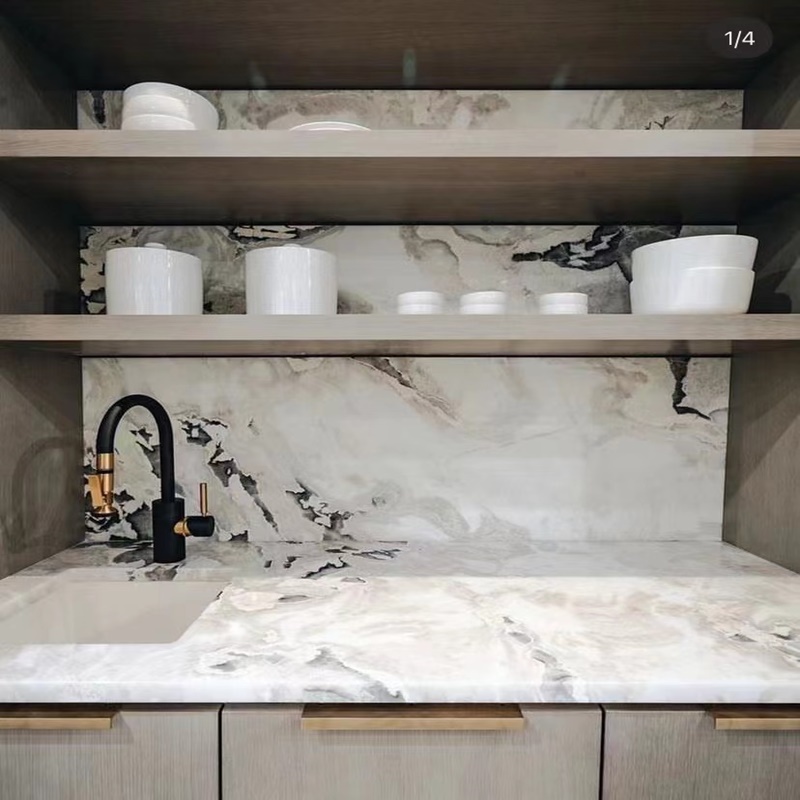
Dover White Marble is a distinctive natural White Marble from Namibia. Its appearance combines cream-white to ivory crystalline areas with smoky light-grey and darker grey mineral structures that move irregularly through the slab.
The visual character is broader and more geological than a conventional fine-veined white marble. Some areas can appear relatively calm and luminous, while other sections develop strong cloudy, ribbon-like or crystalline formations.
This contrast makes Dover White especially suitable for projects where the natural slab itself is intended to become an architectural feature.
Product Specifications
| Specification | Project Details |
| Material Name | Dover White Marble |
| Material Type | Natural Marble |
| Origin | Namibia |
| Related Trade Names | Oyster White Marble / Fendi White Marble / Caribbean White |
| Primary Colors | Ivory White / Cream White / Light Grey / Smoky Grey |
| Texture Pattern | Crystalline / Cloudy / Flowing / Irregular Grey Mineral Movement |
| Available Slab Size | Subject to Current Block and Slab Inventory |
| Available Tile / Custom Size | Cut-to-Size According to Approved Drawings and Project Requirements |
| Available Thickness | 18mm / 20mm |
| Surface Finishing | Polished / Honed / Project-Specific Finish |
| Edge Options | Straight / Eased / Beveled / Mitered / Custom Profile |
| Application | Walls / Islands / Countertops / Vanities / Tables / Floors / Interior Stonework |
| Package Details | Protective Separation + Edge Protection + Reinforced Fumigated Wooden Crates |
| Payment Details | T/T or Agreed Commercial Terms |
| MOQ | Subject to Slab Availability and Fabrication Scope |
| Delivery Time | Confirmed According to Quantity, Fabrication and Current Material Availability |

Namibia Marble with Crystalline Movement
As a Namibia Marble, Dover White has a visual language defined more by large mineral structures than by predictable linear veining.
A typical Namibia White selection may contain broad ivory areas beside grey crystalline bands, while another slab can show stronger smoky movement across much of its surface.
For this reason, a small sample is useful for confirming basic color and finish, but it should not be the final visual approval for a large project.
Related Trade Names and Material Approval
Dover White may appear in the international stone market under related names including Oyster White Marble, Fendi White Marble and Caribbean White.
Trade names should be treated as a sourcing reference rather than a substitute for physical material approval. Quarry section, block selection, slab finish and individual geological structure can all influence the final appearance.
Recommended B2B Approval:
Material Name → Current Full-Slab Photos → Slab Numbers → Quantity Grouping → Finish → Cutting Layout → Final Buyer Approval
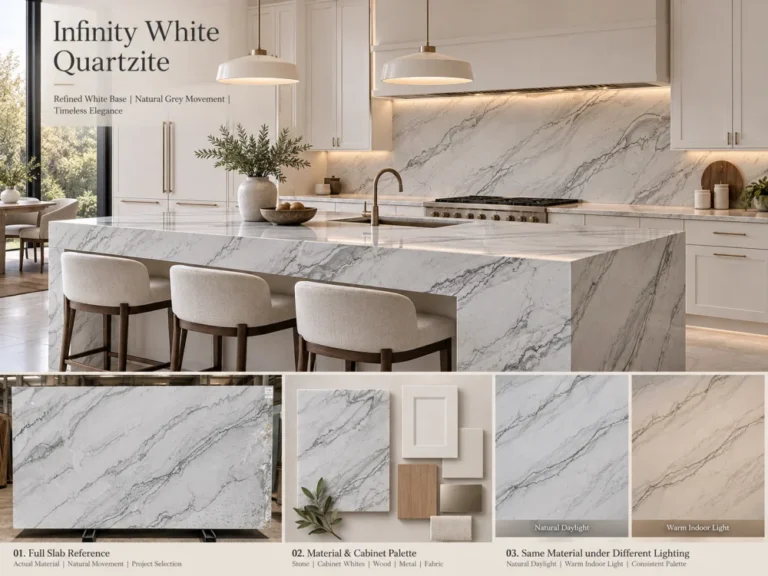
Dover White Marble Slab Selection
Purchasing a Dover White Slab should begin with full-slab photographs under consistent lighting. Buyers should compare overall brightness, crystal concentration, grey movement and the location of dominant natural structures.
For a multi-piece project, several Dover Marble Slab pieces should be viewed together. This makes it easier to identify slabs suitable for the same elevation, island or room.
A large White Marble Slab may contain both quiet and highly expressive zones. Those zones can be assigned strategically during cutting rather than treated as defects or unwanted variation.
For each Marble Slab, usable cutting area should also be evaluated against finished component dimensions before final material quantity is calculated.
Luxury White Marble Applications
As a Luxury White Marble, Dover White can provide a bright neutral base without appearing visually flat.
The crystal-rich areas create depth at close range, while broad grey structures remain visible across larger architectural surfaces.
This combination works particularly well with warm timber, bronze or champagne metal, cream cabinetry and restrained contemporary interiors.
Large-format use is often the most effective because it preserves the natural geological scale of the material.

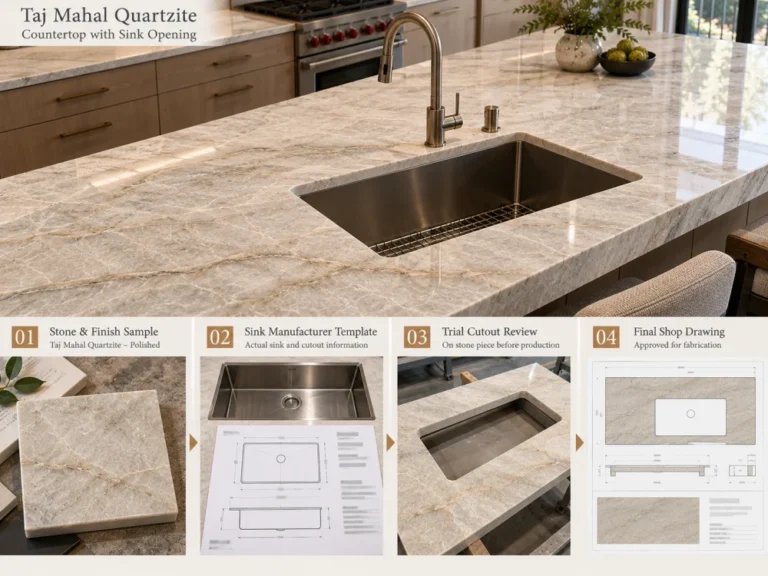
Dover White Marble Countertops
A Dover Countertop combines a light natural-stone palette with a more expressive geological structure than a visually uniform white surface.
For a White Countertop, buyers should review exactly where the main grey and crystalline formations will fall within the finished dimensions.
When fabricating a Marble Countertop, sink and cooktop openings should be positioned on the approved slab layout before cutting. A large opening can otherwise remove an important crystal formation or leave the remaining pattern visually unbalanced.
Countertop Layout:
Full Slab → Finished Template → Main Viewing Area → Sink / Cooktop → Seam → Edge Profile → Cutting Approval
Dover White Marble Kitchens and Islands
A Dover Kitchen can use the material as either a primary island surface or as coordinated countertops and backsplashes.
A large Dover Island is particularly effective because the uninterrupted top provides enough area for the crystalline structure to remain legible.
For a Marble Island, the primary viewing side should be identified before slab nesting. This allows the strongest natural composition to be positioned where it has the greatest design value.
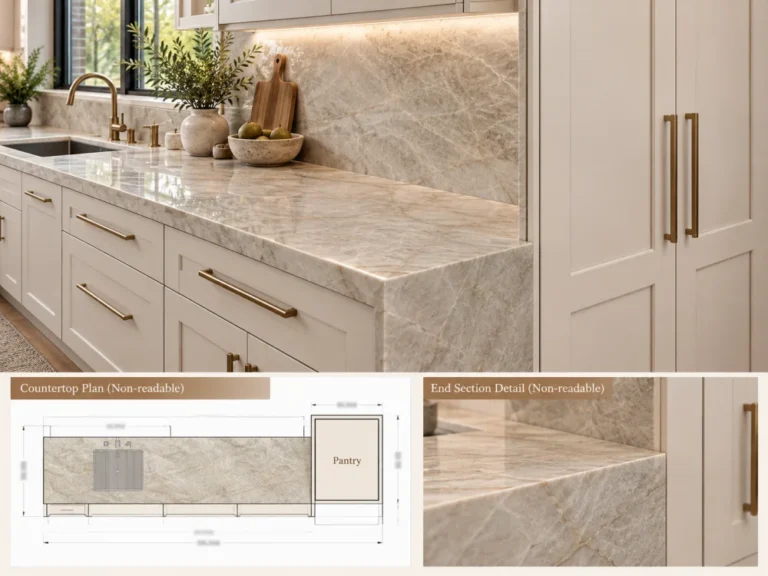
Waterfall Island Pattern Planning
A Waterfall Island requires the horizontal top and vertical end panels to be treated as one visual assembly.
The selected slab areas should be compared before cutting to determine whether the grey movement can transition naturally around the mitered edge.
Where a direct continuation is not practical, the goal should be a balanced relationship rather than forcing an artificial pattern match.
Waterfall Review:
Island Top → End Panels → Crystal Direction → Grey Movement → Miter → Support → Trial Assembly
Dover White Marble Table Tops
A custom Dover Table Top can preserve one selected crystalline formation as the main visual feature of the furniture.
For a Marble Table Top, round, oval and irregular templates can be rotated over the slab photograph before cutting. This allows different compositions to be compared while also improving material yield.
Edge geometry, base-support locations and finished stone weight should be coordinated before production rather than determined after the tabletop is cut.
Dover White Marble Vanity Applications
A Dover Vanity works well in bathrooms that require a light natural palette with more geological depth than a plain white surface.
Basin openings, backsplash strips and side returns should be mapped together where possible. For double vanities, this prevents two basin cutouts from unintentionally disrupting the most important crystalline structures.
The stone can also coordinate with matching wall panels to create a more integrated bathroom specification.

Dover White Marble Feature Walls
A large Dover White Wall allows the full geological structure of the material to become part of the architecture.
For lobby walls, residential feature walls and reception areas, the complete elevation should be planned before fabrication.
Panel joints should respond to the slab composition instead of dividing major crystalline areas randomly.
Bookmatch Marble Planning
Some consecutive Dover White slabs may be suitable for a Bookmatch Marble arrangement, particularly where broad grey structures or crystal bands create a strong mirrored composition.
Bookmatching should be confirmed using the actual available slab pair. A digital mirror preview can be prepared first, followed by panel numbering and dry-lay review where appropriate.
Bookmatch Workflow:
Consecutive Slabs → Mirror Preview → Wall Elevation → Joint Position → Cut Numbers → Dry-Lay → Approval
Backlit Marble Considerations
Crystal-rich areas of selected Dover White slabs may offer potential for Backlit Marble applications, but light transmission should never be assumed to be uniform across the complete slab.
Denser grey mineral structures and different crystalline zones may transmit light differently. The actual intended cutting areas should therefore be tested before fabrication.
For a large illuminated wall, stone selection, panel thickness, support design, lighting distribution and access for future maintenance should be coordinated as one system.
Surface Finishes and Fabrication
Polished Finish
Polishing emphasizes crystal depth, tonal contrast and the relationship between ivory-white and smoky grey areas.
Honed Finish
Honing reduces reflection and produces a softer architectural appearance while retaining the natural mineral structure.
Custom fabrication can include cut-to-size panels, countertops, vanity tops, CNC profiles, sink and cooktop openings, mitered edges, table tops, wall panels and other project-specific components.
Natural Variation and Procurement Risk
The main procurement risk with Dover White is expecting every slab to reproduce the appearance of one reference image.
Natural variation can affect white tone, crystal size, grey concentration, pattern direction and the amount of visually quiet material available for cutting.
For repeat rooms, multi-unit developments or large wall packages, slabs should be grouped according to the approved visual standard before fabrication begins.
| Procurement Risk | Recommended Control |
| White tone differs between slabs | Group slabs under consistent lighting before approval |
| Strong pattern falls inside cutout | Overlay finished templates before cutting |
| Adjacent pieces appear unrelated | Approve piece sequence and orientation |
| Backlight result is uneven | Test actual selected cutting areas before production |
Custom Fabrication and Quality Control
Fabrication should follow approved shop drawings and the confirmed slab layout. Once cutting begins, the relationship between finished component numbers and original slab positions should remain traceable.
Approved slab numbers
Finished size inspection
Orientation verification
Position and geometry
Profile and miter quality
Finish consistency
Adjacent piece relationship
Pre-packing inspection
Packaging and Delivery
Dover White finished components require packaging planned around their actual dimensions, thickness, edge geometry and cutouts.
Finished surfaces are separated with suitable non-staining protective materials. Exposed corners, mitered edges, narrow strips and areas around large openings receive additional protection according to their fracture risk.
Components are secured inside reinforced fumigated wooden crates with appropriate internal blocking and separation. Production inspection is completed before packing, while export documentation and logistics support can be coordinated according to the agreed trade terms and destination.
Why Choose HRST STONE
HRST STONE provides one-stop natural stone solutions backed by 17+ years of stone supply and project experience. For visually variable materials such as Dover White Marble, support extends beyond supplying slabs.
Project services can include current slab selection, full-slab photography, CAD and shop-drawing coordination, cutting-layout review, custom fabrication, production tracking, dry-lay inspection, final QC and export packing.
This process helps designers, contractors, distributors and project buyers control both the natural appearance of the material and the practical requirements of fabrication and international delivery.
Information Required for Quotation
| Quotation Item | Information Required |
| Application | Wall / Countertop / Island / Vanity / Table / Floor |
| Dimensions & Quantity | Finished sizes, quantity schedule or CAD drawings |
| Thickness | 18mm / 20mm or specified project requirement |
| Finish | Polished / Honed / Other specified finish |
| Visual Preference | Cleaner white / stronger grey / crystal-rich / balanced movement |
| Fabrication | Cutouts / Edge profile / Miter / Bookmatch / Pattern matching |
| Destination | Destination port or complete project delivery location |
Dover White Marble FAQ
1. What is Dover White Marble?
Dover White Marble is a natural marble from Namibia with ivory-white crystalline areas and irregular grey mineral movement.
2. What color is Dover White Marble?
Its palette generally ranges from ivory and cream white to light and smoky grey, with the exact balance varying between slabs.
3. Is Oyster White Marble another name for Dover White?
Oyster White is used as a related commercial name in parts of the stone market. Buyers should confirm actual slab photographs rather than rely on trade naming alone.
4. Can Dover White Marble be used for kitchen countertops?
Yes. It can be fabricated for countertops, although buyers should consider the normal care requirements associated with natural marble.
5. Is Dover White suitable for large kitchen islands?
Yes. Large islands are particularly suitable for displaying its crystalline structure, provided the slab layout is approved before cutting.
6. Can Dover White Marble be bookmatched?
Selected consecutive slabs may be suitable for bookmatching. The actual slab pair should be mirrored digitally and reviewed before fabrication.
7. Can Dover White Marble be backlit?
Some crystal-rich areas may transmit light, but the effect varies naturally. Actual selected areas should be tested before a backlit project is approved.
8. Should buyers approve the actual slabs before cutting?
Yes. Full-slab approval is recommended because white tone, grey movement, crystal density and usable cutting areas vary naturally.
9. What thicknesses are normally available?
18mm and 20mm are common project options, subject to current material availability and fabrication requirements.
10. How are fabricated Dover White Marble pieces packed?
Finished pieces are inspected, protected according to surface and edge conditions, separated appropriately and secured inside reinforced fumigated wooden crates for export.
Final Note
Dover White Marble is best purchased through a slab-first workflow. For large walls, group and sequence compatible slabs before panel cutting. For islands and countertops, position major crystalline structures before locating sinks, cooktops and seams. For table tops, compare alternative template orientations before cutting. For bookmatched installations, approve the actual consecutive slab pair. For backlit features, test the intended cutting areas rather than assuming uniform translucency. Full-slab approval, CAD layout, fabrication inspection and protected export packing give B2B buyers greater control over both appearance and delivery risk.